
Building Through Collapse
Lineage, Meaning, and the Coming Order

Building Through Collapse: Lineage, Meaning and the Coming Order
This began as a note to a friend. It does not go especially deep, but it draws together some of the themes I’ve been working on understanding better for some time: the symbolic collapse of the West, the exhaustion of the progress narrative, the need for reconstituted meaning, and how one might begin - not to preserve what was - but to build in and through the structure of collapse itself.
The West’s Quiet Unravelling
In the West today, we are witnessing the unmaking of a civilisation. The visible signs - brittle institutions, financial pathology, political decay - are real, but secondary. The deeper crisis is epistemic. What is dissolving is not only what we know, but how we come to know it, why we once knew it, and what made such knowing meaningful. A civilisation loses coherence when its inner language falters - when it no longer remembers how to narrate the world to itself.
The stories that once lent the West a sense of purpose - Christian teleology, Enlightenment rationalism, modernist faith in improvement - offered more than content. They structured time, fate, hierarchy, and the human soul. Those myths were not perfect, but they carried weight. They gave shape to history and a shared interior to society. Their exhaustion has left a vacuum. In place of purpose, we have procedures; in place of destiny, quarterly targets. In place of memory, metrics.
The result is not simply disintegration, but disorientation: a society whose symbolic structure has collapsed inward, even as its exterior forms remain standing.
Myth and the Loss of World
To lose myth is not just to lose stories—it is to lose the medium through which significance travels. Myth is not explanation; it is patterned recognition, a way of seeing that binds the visible to the invisible, the moment to the eternal. It grants events their shape and weight. When myth is intact, life is lived inside meaning. When myth breaks, meaning becomes anecdotal, temporary, local - and eventually optional.
The modern West has forgotten how to see symbolically. It lives among fragments: ideologies that no longer believe in themselves, identities unmoored from memory, markets animated by the language of freedom and the logic of compulsion. We live in a high-frequency void, bombarded with information and deprived of narrative. The world has become legible to machines but illegible to souls.
Scientific rationalism, once the great dismantler of myth, promised mastery in exchange for mystery. It has delivered abstraction instead. Even its gifts of technological power, precision, scale come at the cost of symbolic collapse. What was once storied has become quantified. What was once morally thick has become operationally efficient. The world is now flat, and we are told this is progress.
But without myth, we cannot perceive depth. We cannot transmit meaning. And without meaning, we cannot inhabit time.
Civilisational Exhaustion and the Story That No Longer Holds
The epistemic fracture is accompanied by civilisational fatigue. The progress narrative - once the West’s master story - is spent. It once offered direction and moral elevation: a movement toward freedom, wealth, enlightenment. But its core assumptions no longer persuade. Material progress (or its simulacrum) has decoupled from spiritual vitality. Institutional competence has been replaced with inertia. Public rhetoric has grown thin and managerial, unable to summon loyalty or sacrifice.
Finance is the most visible symptom. Once the pragmatic cornerstone of the West’s claim to order, it has become a theatre of illusion. A system propped up by central bank signalling, euphemistically-renamed and statistically-concealed inflation, and the hollowing of productive capacity still floats - but only because it cannot fall. Capital is trapped. Trust is managed. The mechanisms persist, but the story is broken.
This is not simply mismanagement. It is a deeper form of disintegration: a culture that no longer knows why it builds cannot build well. The institutions that once encoded memory and authority - education, law, science, even the media - no longer offer coherence.
They simulate their former functions.
They no longer provide a map and they do not perform the critical function of mimesis, of showing what a well-formed life, judgement, or polity looks like through example, ritual, or living symbol. Without mimesis, culture cannot reproduce itself. It cannot transmit what it values because it no longer remembers how to embody value. In such a condition, the young are not initiated—they are exposed. They inherit systems with no centre, gestures with no origin, and roles with no archetype. The result is not merely confusion, but a deepening inability to even recognise what is missing.
The question is no longer how do we fix the system? but what made us believe in it to begin with? And if that belief has collapsed, what comes next?
Central Asia and the Return of Liminal Power
In this widening rupture, some geographies begin to feel charged. Central Asia - long peripheral in the Western mind - emerges not as a new global centre, but as a symbolic frontier. A place where civilizational lineages still co-exist in tension, where no single narrative has achieved full saturation or erasure.
Its importance lies less in inevitable ascendancy than in what it has not yet exhausted. It is one of the few spaces where Persianate metaphysics, Soviet bureaucratic residue, Turkic memory, and Islamic legal traditions still breathe, not yet flattened by global managerialism. It was never fully absorbed into the West’s symbolic order, and for that reason, it may be more vital in the future than the core.
Strategically, its position between China, Russia, and Iran matters. Geo-economically, it is shaped by the return of land over sea, corridor over chokepoint. And culturally, it still holds traces of a plural symbolic grammar - oral and literary, tribal and imperial, mystical and bureaucratic. It is not the answer. But it is not yet closed.
Those who take lineage seriously - families, orders, networks - may find in such places not a refuge, but a zone of reassembly. Central Asia is not a utopia. But in a world of exhausted centres, its opacity is a kind of possibility.
Education Beyond System: Apprenticeship and the Recovered Real
A civilisation that forgets its myths forgets how to educate. The West’s educational institutions, long seen as its great strength, now reveal their hollowness. Their outer form persists: degrees, rankings, credentials. But the inner current is gone. They no longer teach what it means to be human, nor equip their students to face ambiguity, suffering, or the tragic.
True education is not instruction. It is formation. And formation cannot be mass-produced. It occurs through apprenticeship: not just to a skill, but to a way of being. This kind of learning involves exposure to complexity in the world, under the guidance of someone who carries memory and coherence. It cannot be substituted with frameworks or toolkits. It must be lived.
AI tutors will play a role, but they must be placed correctly. They can accelerate retrieval, simulate conversation, and help pattern information. But they cannot confer wisdom. They cannot model moral perception. Used properly, they can supplement apprenticeship. Misused, they will obscure the absence of formation by simulating competence.
In the absence of educational institutions that form character, the burden falls elsewhere: on families, on private orders, on those small and durable structures that still transmit meaning across generations.
Lineage as Strategy, Not Sentiment
In a world like this, there is no single path. What must be done depends on what you are, where you're from, and what you believe. But one pattern emerges across many possibilities: the future will belong to lineages.
By lineage, I do not mean bloodlines or nostalgic aristocracy. I mean continuity. A structure of transmission - not only of wealth or property, but of memory, symbolic grammar, and orientation in time. A house - however constituted - that knows what it stands for, what it can trade, and what it cannot.
Lineage is not justified by success, but by fidelity: to origins, to limits, to a symbolic pact that precedes utility.
To prepare the next generation is no longer a matter of equipping them with credentials. It is a matter of wisdom: of helping them perceive clearly, suffer nobly, and act when the moment comes. That requires orientation - across languages, across histories, across rites of passage. One learns Russian or Persian or Turkish not merely to trade or travel, but to begin to access alternate symbolic worlds. These are not just languages, but legacies. To speak them well is not yet to be formed by them - but it opens the possibility. In time, with immersion and fidelity, such languages can become vessels of perception, shaping how one sees, remembers, and interprets. Fluency alone is not enough. But without it, the deeper crossings are closed.
It is possible, paradoxically, that deeper divergences will first appear as an acceleration of convergence. Live AI translation may soon erase the transactional advantage of speaking other languages. Some already downplay the importance of language learning, imagining that fluency will be automated. This will benefit those in linguistic redoubts - like Serbia - where local speech has little global reach. But in the West, it is likely to hasten a collapse in elite linguistic competence: why bother, if translation is instant?
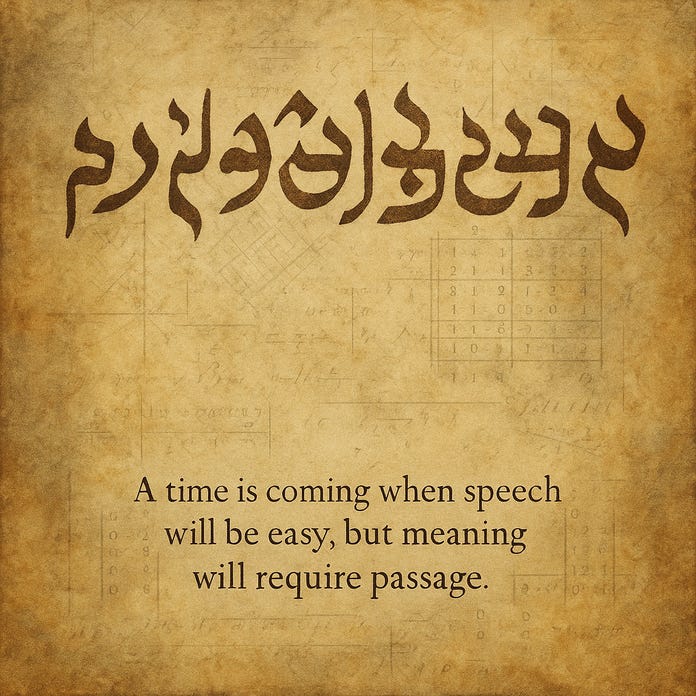
Yet over time, this thinning will increase the symbolic return to real fluency. What will matter is not translation, but transposition - not rendering a phrase, but inhabiting a world. The ability to think in another civilisation’s metaphors, to perceive its sensibilities from within, will become rarer, and more valuable. A time is coming when speech will be easy, but meaning will require passage.
Success will not go to those who navigate the existing order most deftly, but to those who build forms that endure its disintegration.
Collapse Is a Structure and a Condition
Collapse is not an event. It is not something that happens, after which something else begins. Collapse is a structure - a system whose contradictions generate self-perpetuating breakdown - and it is a condition, a lived reality of disorientation and exhaustion. It continues even as we think it is ending. It adapts to every attempted exit.
Collapse must be inhabited: seen not as interruption, but as the terrain. It is not the obstacle to building, but the shape of the world in which building begins.
This is what makes it so difficult to name. The surface persists - laws, currencies, rituals of legitimacy - while the inner life has already departed. Hollywood has taught us to expect collapse as spectacle: a sudden, cinematic rupture. But the more devastating form is slower, quieter - the death of meaning beneath a façade of continuity. And because it offers no event to mark, it often escapes our perception entirely.
That is why building now must happen through collapse, not beyond it. Not restoration, not revolution, but discernment. Quiet planting. Strategic memory. Embedded formation. Families who remember. Networks who hold form. Children who are not made entirely of noise.
Those who think across time - who carry myth, practice craft, and navigate collapse not as spectacle but as structure - may not inherit the earth. But they will remember how to tend it - and how to endure, while others forget what a garden even is.
Really interesting thank you. Within your observation of linages and myths I would include observations and research about individuals vs communities. The sense of purpose which comes from community and altruism has some interesting patterns in social anthropology.
Thanks, Jess.
Any reading suggestions?
Oxytocin is a hell of a drug! Ie it seems that pro social behaviour cuts in two directions - empathy and altruism towards the group also accompanies territoriality and hostility towards outgroups.